
West 9th Residence
ResidentialAustin, TexasA 1934 Clarksville home, taken down to the studs and built back with intent.
Photography: Antoine Bootz
- Architect: Tom Hurt
- Builder: EEF Homes
- Landscape Architect: Campbell Landscape Architecture
- Millwork: Mule Studio
- Steel Fabrication: Arclight Fabrication
A 1934 Clarksville home, taken down to the studs and built back with intent.
In Clarksville, a 1934 home stripped to the studs. The original staircase survived. So did the long-leaf pine floors. Everything else had to earn its place. This was our fifth built project for a semi-retired entrepreneur couple who split their time between Austin, Whitefish, Montana, and international travel. Our relationship began thirteen years ago with the W Penthouse downtown and has continued through a jet interior and an ongoing Whitefish cabin, with other projects along the way that never left the drawing board. West 9th was to be their Austin home base. A little over three thousand square feet. Many small rooms. A brief that asked for less house and more considered.
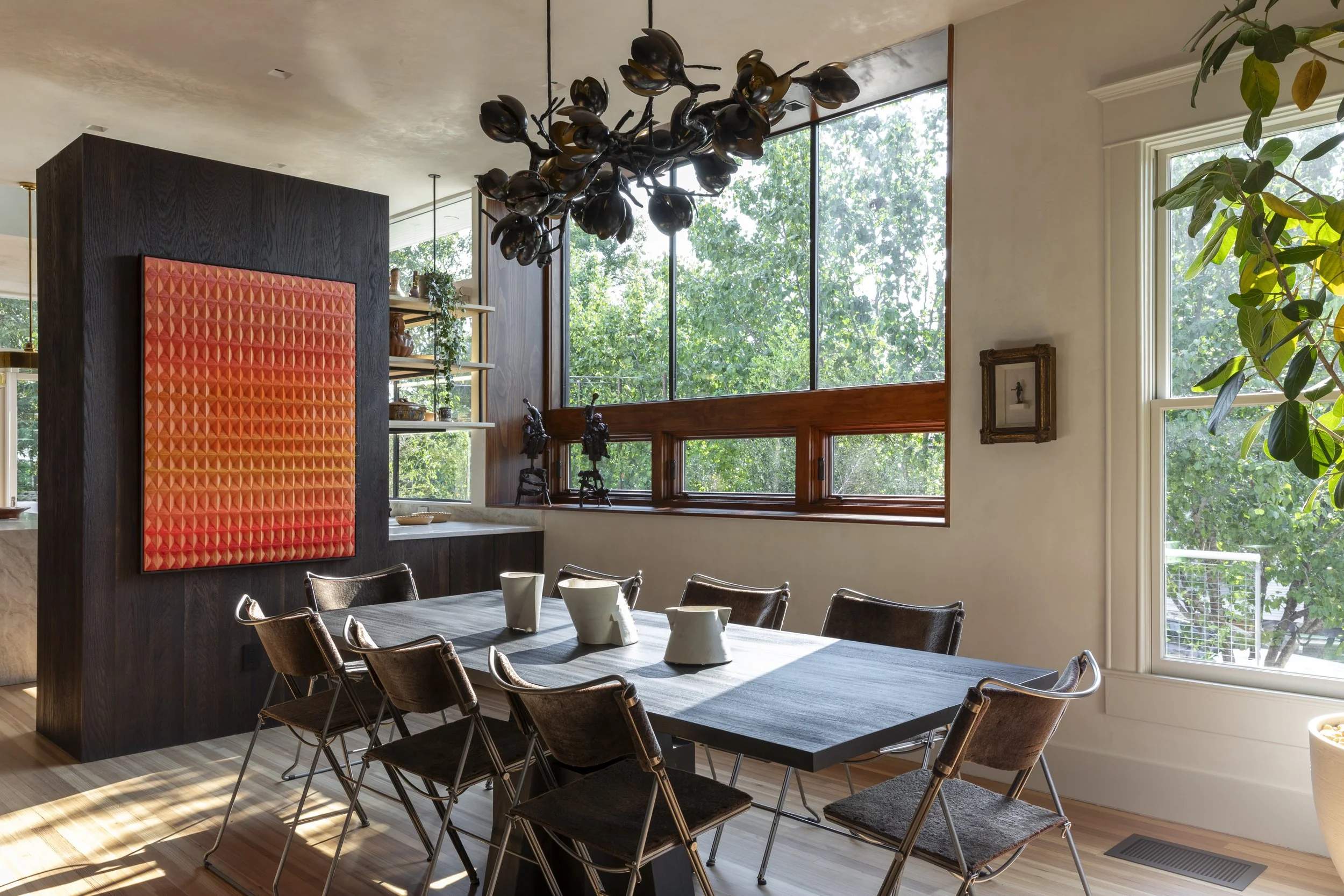
Tom Hurt, who had renovated the house twenty years earlier, returned to specify new windows, a back deck, and an exterior spiral staircase. EEF Homes built the work. Campbell Landscape Architecture, founded and led by Cameron Campbell, handled the exterior. The most distinctive move inside this Clarksville renovation is a wood-and-steel spine that runs south to north through the downstairs, dividing the living room, powder room, and guest suite on the west from the dining room, kitchen, and breakfast room on the east. A spine existed from the earlier renovation, but it was tired and it reached the ceiling, cutting off the light and compressing the rooms. We rebuilt it at the level the house deserved and stopped it short of the ceiling. Light now streaks across the house. The wood is deep-wirebrushed for texture, then burned and stained to a furniture-grade finish that anchors the downstairs. Steel shelving plays counterweight: equal in visual mass, lighter in dimension. Mule Studio built the millwork. Arclight Fabrication built the steel.
Specific pieces carry the tone. In the entry, a bench of our design: a custom steel base topped with five hundred and eighty pounds of solid glass brick, fabricated by Growler Domestics. The bench was not in the original program. The clients asked for a shoes-off house after move-in, and the challenge was how to add a functional piece without interrupting the light that streaks across the floor. The glass brick solved it. In the living room, a pool table of our design. When it came time to select a pool cue rack to hang on the wall, no existing option met the standard the room required. So we commissioned one from Dutch artist Nestor Rotsen, clad in his signature handmade ceramic tile. The cabinet conceals its function until the homeowner reveals the secret to guests on the tour. In the dining room, a custom bronze floral sculptural chandelier by 7 Gods anchors the space.
The basement recovery room is the project's contrarian decision. Cold plunge, hyperbaric chamber, sauna. A small windowless space. The conventional question would have been how to brighten it. We asked the opposite. We leaned into the dark. Faux wood vinyl floors handle the wet environment (the right material here, not the obvious one). Clear western cedar lines the sauna and the hyperbaric chamber. Walls and ceiling are finished in deep charcoal Venetian plaster. The mood is peace and restoration, not brightness. On the third floor, a compact gym opens to downtown views, packed with Olympic-grade Eleiko equipment. Tiny but mighty, by design.