
West Austin Remodel: A whole-house renovation and integrated ADU
Cravotta Interiors Case Study
West Austin is a whole-house remodel of an existing home in central Austin, just west of downtown, paired with a newly built accessory dwelling unit on the same site. It was an older home with exceptional bones, and the remodel worked with the existing architecture rather than against it. The original architecture by Ryan Street Architects established the bones the project preserves. The interior program and the ADU were developed with a young professional couple who had recently purchased the house and wanted it to become specifically theirs.
The brief
The existing house had plaster walls and ceilings, original beams, reclaimed wood floors, and steel windows. The bones were exceptional. The remodel preserved them.
The clients wanted sophisticated spaces for entertaining, a home theater, a fitness and recovery space, room to start and grow a family, and a feeling throughout that could move between everyday ease and formal gathering. They came to the project without a defined aesthetic. They knew how they wanted the house to feel. They did not yet know how to describe it.
Cravotta and his team spent weeks in conversation with the clients before any design decisions were made. The process surfaced patterns: where they travel, what environments restore them, what energizes them, where they linger and where they pass through. A visual exercise of over two hundred images of interiors from around the world framed the aesthetics conversation and sharpened the direction.
With the architecture and the major elements preserved, the work became identity through smaller, deliberate moves. A custom butcher-block island top in the kitchen, scaled to function as a serious prep surface. A custom breakfast nook resolving an awkward space between the kitchen and the stairs. Two powder rooms designed with sharply different material palettes. The conversion of unused basement space into a speakeasy and home theater. Each move specific. The composition layered into the existing house, not pasted over it.
Ryan Street Architects designed the original house but was not involved in the remodel. Cravotta led the interior program. Joe Putman of Bioloom designed the new accessory dwelling unit. Clint Carson of Tofka Construction built the project through completion. Cameron Campbell handled landscape architecture.
What the project required
The project came down to a few clear requirements.
Work within the existing architecture. The bones stayed. The remodel added to them rather than replacing them, and the interior program developed inside the house that was already there.
Add the program the house was missing. The accessory dwelling unit took on the home office, a guest bedroom and bathroom, the fitness space, and the recovery space, organized as a separate building that reads as part of the same property.
Give each space its own purpose. The house is a collection of rooms that each do something specific. No single room governs the others. The work was to make every space distinct and to keep the whole house reading as one place.
The design moves
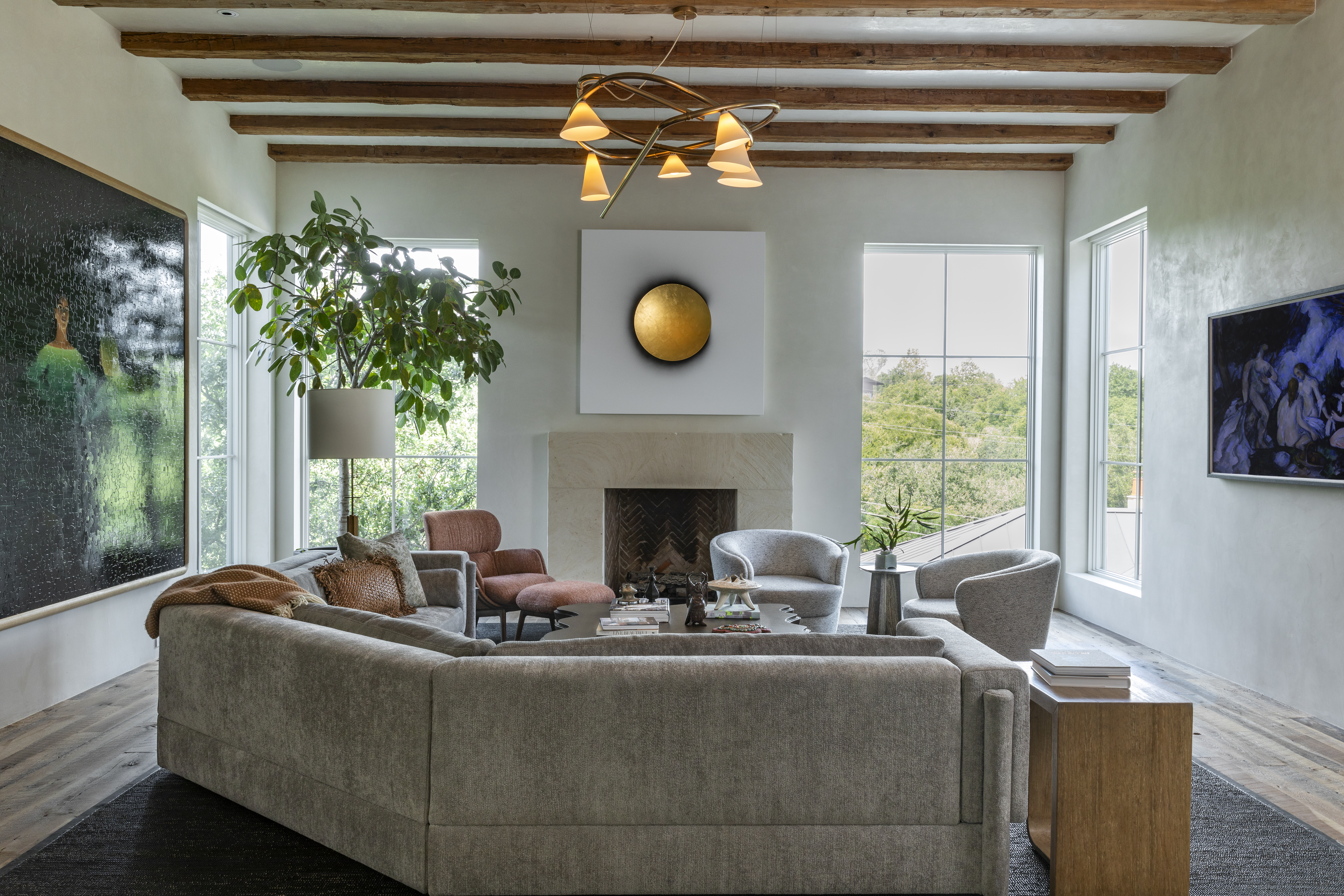
The living room
The living room sits inside the original architecture and adds layers that read against it.
It anchors the home for guests, seats up to eight comfortably, and works as both the visual tone-setter for the house and a place where the family relaxes day to day.
Two artworks set the tone. On the primary wall, a ten-by-eight-foot puzzle painting by Tyler Hays, the artist behind the Philadelphia furniture studio BDDW. On another wall, a solar painting by Lita Albuquerque, a Light and Space artist who works in pure pigment and gold leaf. Around the art: an Anna Karlin chandelier above the seating area, a Louise Liljencrantz coffee table with brass detailing that catches the light, a hand-knotted Lance Woven Leather rug with each loop tied individually, and a custom sofa by Egg Collective, the women-founded studio that designs and builds by hand in its Brooklyn wood shop.
The kitchen, bar, and breakfast nook
The kitchen was reimagined within the existing footprint through a series of specific interventions. The island countertop was replaced with a custom butcher-block top of monumental scale, intended to work both as an aesthetic anchor and a serious prep surface. A new backsplash in handmade tile, new floating shelving, and a new vent hood completed the kitchen. How that top was designed and fabricated is covered in our essay on custom furniture design.
A pass-through space between the kitchen and the dining room was converted into a small bar. The reuse closed a circulation gap that read as awkward in the original plan.
Between the kitchen and the stairwell sat a space too small to be a room of its own and too large to leave undefined. Cravotta designed a breakfast nook for it. The banquette was built by Litmus Industries and upholstered by Plush Home. The table was built by Mark Macek, an Austin furniture maker trained as an architect, who builds made-to-order pieces in his East Austin shop. He made this one in wenge on a steel base. Both pieces were designed by Cravotta and specified together, so the proportions, the wood, and the finish read as one piece of furniture rather than two. The nook is the move the family uses every day.
The dining room
The dining room is one of the most important spaces in the house, and the first you see when you come through the front door. A vaulted ceiling with hewn beams sets its scale. A carved limestone fireplace surround anchors the room.
A Jeremy Maxwell Wintrebert chandelier in handblown glass hangs above the table, sized to the volume of the room. Wintrebert freehand-blows each piece in his Paris atelier under the Viaduc des Arts, working molten glass into a brass nest that is then removed, so no two pieces match exactly. He calls glass liquid light, and the room reads that way after dark. The room seats ten. The dining chairs are by Rose Tarlow, upholstered in a dusty rose Belgian linen bouclé that keeps the room fresh and casual rather than formal.
The artwork above the fireplace is by Clement Rosenthal. Antique Buddhist temple figures flank it, carved from burlwood, the monks laughing and dancing, as if to invite a festive mood for dinner guests.
The two powder rooms
The two powder rooms read entirely differently, and intentionally so.
The first powder room is faced in custom reeded teak paneling, designed by Cravotta for the space. The vanity is custom, fabricated from solid honed black granite. The effect is architectural, restrained, and deeply material.
The second powder room is warmer and more patterned. The walls carry handmade ochre matte glazed tile, paired with a handmade batik wallpaper. The pairing gives the room an atmosphere distinct from anywhere else in the house, layered and textural in a way the more restrained spaces are not.
The basement: speakeasy and home theater
Below grade, unused storage and utility space became a speakeasy and a home theater. The two rooms connect, and the materials and the mood carry from one to the next.
The design takes the 1920s as its source. It was an era of high glamour: dark wood paneling, saturated fabrics, warm and dim light, aged brass, glass, and tilework. The reference points run from Jean-Michel Frank to the grand cruise ships, the Orient Express, and the nightclubs of Paris, New York, and Miami. The basement draws on that language without reproducing it.
The speakeasy stands on its own as an intimate space for four to six people. The home theater opens into a larger area that seats twelve. In Common With pendants light both rooms. They are dim by design, layered in material, and sealed off from the daylight world upstairs.
The primary bedroom and her home office
In both rooms, Pierre Yovanovitch lounge chairs set the tone. The French designer first shaped the Asymmetry chair in modelling clay, without a drawing, and it is still upholstered by hand in Lyon to fit each curve of the form. The clients describe it as a functional sculpture that feels like a hug to sit in.
The two rooms are a quiet, deliberate composition, calmer than the entertaining spaces downstairs. The bed, bench, and chair and ottoman are upholstered in soft, textural fabrics woven from natural fibers: alpaca, linen, and cotton. Quiet original paintings hang on the walls. Nothing announces itself. The materials are substantial without display, scaled and finished for daily use rather than performance.
The accessory dwelling unit
The ADU houses a home office, a guest bedroom, and a guest bathroom upstairs. The fitness space and the recovery space are downstairs. Joe Putman of Bioloom designed the building. The ADU is architecturally different from the main house and reads as part of the same property without imitating the main house's language.
The fitness room is built to the standard of a serious professional athlete: full Olympic-grade equipment, room to move, the program of a private high-end gym.
The recovery room is the project's most contrarian environmental choice. It is a small, windowless space. The conventional question would have been how to brighten it. The decision instead was to lean into the dark and turn the space toward restoration. Two cold plunges are built from the same chiseled limestone that wraps the floor and the lower walls. Above the limestone wainscot, reeded cedar paneling lines the walls and the ceiling. The attached sauna, sized to hold ten people, is finished in cedar on every surface. The room also includes showers, finished in the same materials. The result is immersive and restorative rather than performative.
Press
Featured in Tribeza, May 2026.
Photography
Photographer: Antoine Bootz.
Collaborators
Architecture, construction, landscape, and photography
- Original architecture: Ryan Street Architects (designed the original house, not involved in the remodel)
- Interior design: Cravotta Interiors
- Accessory dwelling unit: Joe Putman, Bioloom
- Construction: Clint Carson, Tofka Construction
- Landscape architecture: Cameron Campbell
- Photography: Antoine Bootz
Art, artists, and galleries
- Living room puzzle painting: Tyler Hays, BDDW
- Living room solar painting: Lita Albuquerque
- Dining room artwork: Clement Rosenthal
Furniture and lighting, living room
- Chandelier: Anna Karlin
- Coffee table: Louise Liljencrantz
- Rug: Lance Woven Leather, hand-knotted
- Fringe pillows: Lance Woven Leather, custom
- Sofa: Egg Collective, Brooklyn
- Side table: Rose Tarlow, Lapidus
- Side table: The Future Perfect, Side Table 162
- Side table: Alexander Diaz Andersson, Geometrik Emerald Table, through Atra
- Lamp: Metier, Los Angeles
- Sofa pillow fabric: Jiun Ho, Los Pantanos
- Wall-hanging bookshelf: Fair Furniture, European walnut
Furniture and lighting, kitchen, bar, and breakfast nook
- Butcher-block island top: Half Halt Studio, white oak
- Counter stools: Stellar Works
- Backsplash tile: Syzygy
- Pendant: RW Guild
- Breakfast banquette build: Litmus Industries
- Breakfast banquette upholstery: Plush Home, workroom
- Breakfast banquette fabric: Marci Mohair, through Canvas
- Breakfast table: Mark Macek, wenge with steel base
Furniture and lighting, dining room
- Chandelier: Jeremy Maxwell Wintrebert, JMW Studio, five Cloud Pendants hung as a composition
- Dining chairs: Rose Tarlow, Abernathy side chair
- Dining table: Arta, Zig Zag Table, through Jean de Merry
- Sideboard: Emmanuelle Simon, Ary Sideboard, through Studio Twenty Seven
Furniture and lighting, primary bedroom and home office
- Lounge chairs: Pierre Yovanovitch, Asymmetry Chair and Ottoman
- Bed: Dmitriy and Co., Kessel Bed
- Nightstands: Piet Houtenbos, Petals side table
- Accent table: STAHL and BAND, L Series 3
- Chandelier: Lostine, Lola
- Table lamps: Pinch, Gentle table lamp, through The Future Perfect
- Rug: Matt Camron, through Canvas
- Bench: Aguirre Designs, Lugano, through Una Malan
- Bench upholstery: Yarn Collective, Marci
- Drapery: Designs of the Time, Isho, through Canvas; fabrication by G and S Custom Draperies
Bathrooms and powder rooms
First powder room — teak and honed black granite
- Reeded teak paneling: Cravotta-designed
- Vanity: honed Absolute Black Granite, through Architectural Tile and Stone
- Mirror: Richard Haining, Scalloped Mirror, through 1stDibs
- Sconce: Atelier De Troupe, Dada
- Ceiling fixture: Obsolete, black metal and satin glass ceiling mount
Second powder room — ochre tile and patterned wallpaper
- Wall tile: Syzygy, Matte White (reads ochre in the room), through Architerra Austin
- Wallpaper: Le Monde Sauvage by Beatrice Laval
- Mirror: Novocastrian, Alnwick, through Galerie Philia
- Sconces: Fuse, Viola, through George Cameron Nash
Speakeasy and home theater
- Pendants: In Common With, Calla Pendant, through STAHL and BAND
- Ceiling mount: Fuse Lighting, Harrington Square, through Dennis Miller
- Wall sconce: McEwen Lighting, Argo, through Dennis Miller
- Cafe tables: West Shop CF, custom
- Banquette: Litmus, custom
- Rug: KASKAS Rugs, antique 1900s Karajeh, Iran, blue
- Bar countertop: Calcatta Machia Vecchia, through Burlington Design Gallery
- Bar front tile: Fireclay Tile, Columbia Plateau Brick