
Driftwood: A new construction vacation home at Driftwood Golf Club, a Discovery Land Company community in the Texas Hill Country
Cravotta Interiors Case Study
Driftwood is a ground-up new construction home at Driftwood Golf Club, a Discovery Land Company community located in Driftwood, Texas in the Hill Country. It is a second home for a family based in San Francisco, built as a part-time retreat for one person and a gathering place for an extended family during holidays and tournament weekends. The same rooms had to carry both modes without favoring either.
The brief
The home sits along an active golf course at Driftwood Golf Club, a Discovery Land Company community in the Texas Hill Country. The architecture was developed by Jenkins Design Build before Cravotta joined the project. It established a clean modern framework with smooth-cut Lueders limestone from Espinoza Stone, wood siding, and ipe decking setting a quiet exterior palette. Interior spaces flow seamlessly to outdoor terraces and frame sweeping views across the course. Landscape design by Craft Outdoor (Micah Langdon).
The clients are an affluent family of five based in San Francisco. Three grown sons, the youngest based in Austin. The family entrusted the youngest with leading the project on their behalf. It was his first major design project. He understood design without claiming the skills to execute it himself. He wanted to be involved without micromanaging. He had the budget to support real material standards and real makers.
The reference point the client offered early in the process was Napa, not traditional Texan. The Hill Country has more in common with wine country than the cliché suggests, and the brief leaned into that. Clean lines. Restrained palette. Real materials. The architectural language of a working landscape rather than a themed one.
Cravotta led the interior program in collaboration with Jenkins Design Build, who developed the home's architectural framework and managed construction through completion. What Cravotta added was the layer that made the house feel like this family's home rather than a generic luxury property: a clear material point of view, depth and restraint in the finishes, and a furniture program organized around how the family actually lives.
What the project required
The project came down to three things.
The material palette. The clients are well-traveled and discerning. They live with real materials and recognize the difference between a real surface and a substitute. The brief required sourcing materials that would extend the architecture's restraint without competing with it. Tone, texture, and the way each material would age into the building over time. Smooth-cut Lueders limestone, wood siding, and ipe decking were already on the architecture. The interior had to carry the same material language inward and add depth without volume.
Furnishing for two modes. The same rooms had to work quietly when one or two people were in residence and expand to host extended family for holiday weekends and golf tournaments. Layout, circulation, upholstery, and finish all had to carry both. Lower profiles and softer forms offset the linear architecture. A few sculptural pieces added contrast. The point was to support how the house lives, not to compete with it.
The setting. Driftwood sits inside an active golf course community. The site informs how the house lives. Interior materials extend outward. Outdoor rooms are furnished with the same intent as the rooms inside. The thresholds dissolve.
The clearest articulation of these priorities came in the dining program. Early in the process, the client described how the family actually behaves. They are close. They cook together. They end up in the kitchen no matter where the house puts the dining room. The plan removed the formal dining room entirely. In its place, three eating zones at different levels of formality: a long kitchen counter bar that seats six for casual meals and conversation with whoever is cooking, a banquette that seats six steps away at a more deliberate dining height, and a ten-seat dining table on the covered terrace just outside. The wall of glass between the kitchen and the terrace slides fully open, so the kitchen and the outdoor table read as one continuous room when the family gathers.
The design moves
Entry sequence
The entry compresses before opening into the main living spaces. Lower ceiling heights and tighter proportions create a moment of pause before the house expands toward the views.
Two materials carry the entry. On one wall, a custom woven leather wallcovering developed in collaboration with Lance Woven Leather. The surface is tactile and quiet. It does not read as pattern from a distance. It reveals itself up close. On the opposite wall, charred cedar from Delta Millworks (the Austin shou sugi ban specialist that pioneered the technique in the United States) runs from the front door, wraps the corner, and forms one side of the long hallway that leads to the guest wing. Three guest bedroom doors are concealed inside the shou sugi ban paneling. On the opposite side of that hallway, a glass curtain wall opens to a sunken courtyard, with the dining terrace and pool visible beyond.
The front door is finished in matte charcoal, grounding the space and letting the wallcoverings carry the visual weight. A sculptural fixture by Giopato & Coombes, sourced through Studio Twenty Seven, sits close to the lower ceiling of the entry, scaled to the compression of the space rather than the volume beyond.
The entry does not announce the house. It calibrates it.
Living room
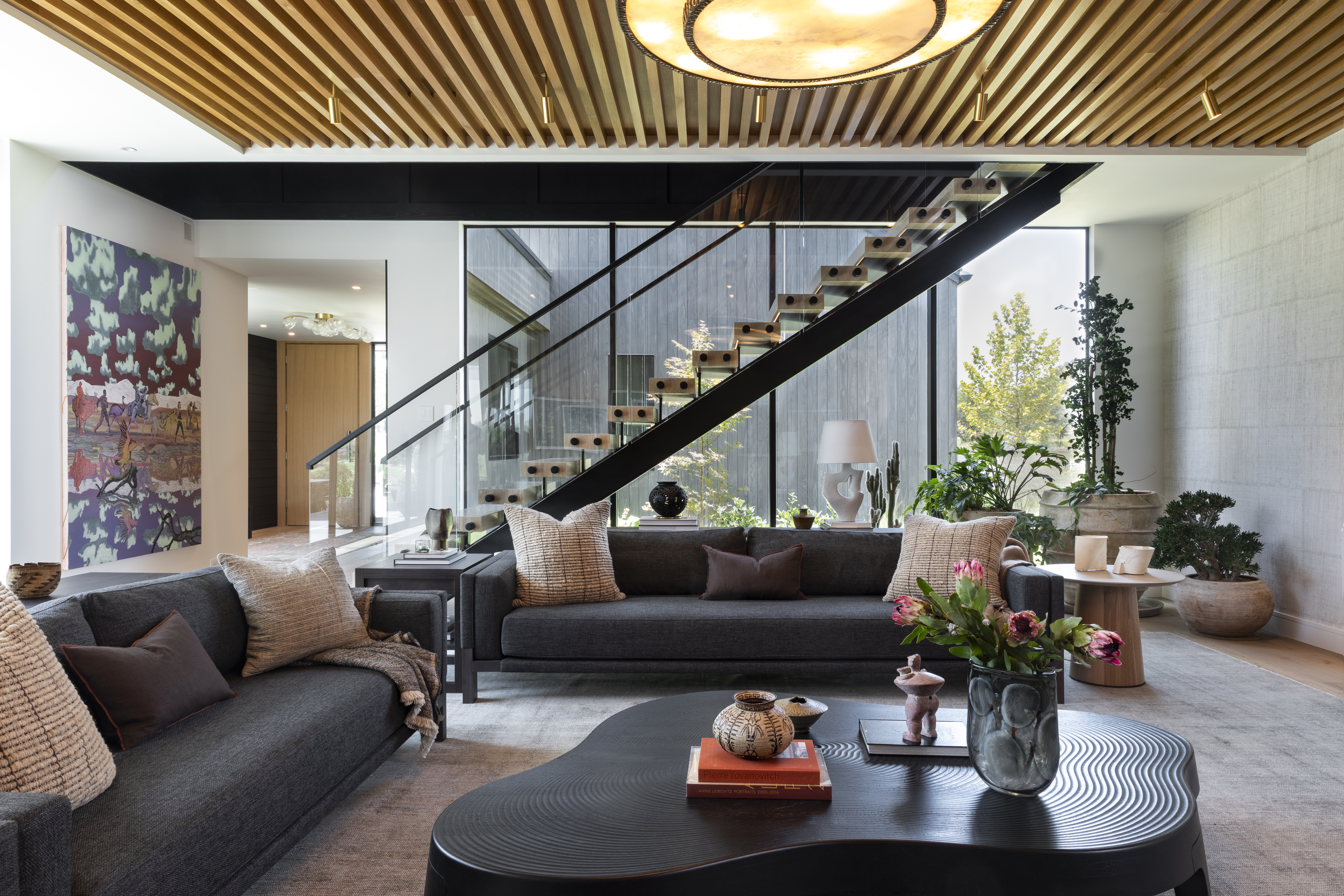
The living room is anchored by two material moves working perpendicular to one another. A continuous wood slat ceiling in white oak extends across the room and turns down one wall as a single rhythmic surface. The slats lower the perceived scale of the room without closing it in. They also conceal the HVAC and lighting that the volume otherwise required, which is why the move was developed in the first place.
The wall perpendicular to the slatted run is the room's main display surface, finished in Mark Alexander's Synamay Chalk wallcovering, from the Collage II collection (Romo Group). Synamay is an open weave of coarse abaca strands mounted to a coloured paper ground, made by hand. At a distance the wall reads as a neutral plane. Up close, the abaca weave becomes the texture of the room.
This is the wall that anchors the home's audio system. A McIntosh amplifier drives a pair of flagship Sonus Faber loudspeakers. Music in this room is meant to do real work, not function as background. The Synamay backdrop gives the system depth rather than flatness behind it.
The living room staircase and seating
The staircase off the living room was developed in collaboration between Cravotta and Jenkins Design Build. The treads appear to float, suspended between two panes of clear glass that serve as both balustrade and visual transparency. The staircase reads as a sculptural object inside the room rather than as a piece of architecture passing through it.
The seating makes a four-sided grouping. Two BOB sofas from the Delcourt Collection sit adjacent, turning a corner to hold two sides, made to order in France on brushed oak bases. A pair of Sheffield club chairs by Fern takes the third side, exposed wood arms drawn from mid-twentieth-century forms, bench-built in American hardwoods at the Hudson, New York studio of Jason Roskey and Maggie Goudsmit. The media console takes the fourth. A Rita chandelier by Maison Leleu hangs above, circular, in raw bronze and white onyx, handmade in France. Leleu is a French house founded in Paris in 1910 and a reference point for French decoration across the twentieth century. Its fourth generation runs it now, with great-granddaughter Alexia Leleu reviving the archive, and the piece reaches the room reissued through The Invisible Collection. A coffee table grounds the center, with a sofa table behind one sofa. Floor and table lamps layered through the room give a soft, shifting light for an evening of music and conversation.
Kitchen and dining
The kitchen is the gravitational center of the house. The dining program described in the brief organizes around it. Counter bar, banquette, terrace table.
The banquette wraps a corner in warm wood and leather and was custom-fabricated by Litmus, an Austin shop. It is the dining room the family actually uses. Sized for six. Built into the architecture rather than placed in front of it.
The kitchen's wall to the terrace is a sliding glass system that opens fully. When the doors are open, the kitchen and the outdoor dining table read as one continuous room. Cooking, eating, and gathering happen in a single space with a porous edge. This is the move that makes the house's two modes possible inside one footprint. The same space carries one person at the counter as easily as fourteen across the indoor and outdoor tables.
Covered terraces and outdoor program
The covered terraces are continuous with the interior, defined less by program than by how the architecture holds the space. The wood slat ceiling of the living room carries through to the covered terrace ceiling. Vertical screen elements filter light and views and create enclosure without closing the space in. Large glass openings dissolve the threshold between inside and out.
Furnishings follow the same language. Wood-framed lounge seating. Upholstered pieces sized for the same scale of conversation as the indoor sofas. Dining elements that match the cadence of the indoor dining program. The outdoor kitchen and bar are built into the architecture rather than added on. When the doors open, the footprint expands. The tone does not change.
Primary suite
The primary suite carries the house's material language at its calmest. The bed is the Sublime, by Barbara Barry for McGuire, a designer whose work runs on restraint and ease, which suits a room meant for rest rather than gathering. A Harlow lounge chair by Holly Hunt sits to one side, a Holly Hunt Studio design that reworks a 1940s French chair on a hand-patinated steel frame, made by hand in the United States. The walls are an Elitis wallcovering. The palette is lighter and the moves are fewer than in the living room, the same logic as the study. Fewer elements, smaller scale, arranged for one or two people.
The study
The study sits at the edge of the house with full-height glazing framing the landscape. Built-in shelving lines three walls in the same wood language as the slatted ceiling work elsewhere, creating a quiet backdrop of books and collected objects. A paneled ceiling defines the room without lowering it.
The desk is by Adam Court, sourced through Studio Twenty Seven, paired with a Minotti chair. The palette is lighter and the material count is tighter than in the living room. Fewer elements. Smaller scale of move. The result is a quieter expression of the house's overall language. Same materials, fewer of them, arranged to support thinking rather than gathering.
Named collaborators
Architecture, construction, landscape, and photography
- Architecture: Jenkins Design Build
- Construction: Jenkins Design Build
- Landscape architecture: Craft Outdoor (Micah Langdon)
- Photography: Antoine Bootz
Custom and fabricated work
- Custom woven leather wallcovering (entry): Lance Woven Leather
- Charred cedar (entry hallway, shou sugi ban): Delta Millworks (Austin)
- Custom banquette fabrication: Litmus (Austin)
- Custom staircase: Cravotta Interiors and Jenkins Design Build (design collaboration; fabrication by Jenkins Design Build)
- Wood slat ceiling fabrication (white oak): Jenkins Design Build
Furniture and lighting, primary spaces
- Entry sculptural fixture: Giopato & Coombes (via Studio Twenty Seven)
- Living room sofas: BOB, Forest & Giaconia for Delcourt Collection (via Avenue Road)
- Living room lounge chairs: Sheffield club chair, Fern
- Living room sofa table: Egg Collective
- Living room chandelier: Rita chandelier, Maison Leleu (via The Invisible Collection)
- Breakfast area pendant: Bianco Light + Space (via The Future Perfect)
- Breakfast dining chairs: Pierre Augustin Rose (via Studio Twenty Seven)
- Covered patio sofa: B&B Italia
- Covered patio lounge chairs: David Sutherland
- Outdoor dining table: Roda (via Scott + Cooner)
- Courtyard chairs: Patrick Naggar (via Ralph Pucci)
- Primary bedroom bed: Sublime bed, Barbara Barry for McGuire
- Primary bedroom lounge chair: Harlow lounge chair, Holly Hunt
- Office desk: Adam Court (via Studio Twenty Seven)
- Office desk chair: Minotti
Bathrooms and powder rooms
- Primary bathroom 1 sconces: Jonathan Browning (via Bright Group)
- Primary bathroom 2 sconces: McEwen (via Dennis Miller)
- Primary bathroom 2 decorative fixture: John Pomp (via Bright Group)
- Powder room 1 mirror: Dumais Made
- Powder room 1 sconces: In Common With
- Powder room 1 ceiling decorative fixture: Margaux Leycuras (via Stahl and Band)
- Powder room 2 mirror: Culp & Associates (South Hill Home)
- Powder room 2 ceiling decorative fixture: Allied Maker
- Powder room 2 wallpaper: Mark Alexander (via Romo Group)
Materials and finishes
- Living room wallcovering: Mark Alexander Synamay Chalk, Collage II (Romo Group)
- Primary bedroom wallpaper: Elitis
- Shou sugi ban entry hallway: Delta Millworks (Austin)
- Lueders limestone exterior: Espinoza Stone
Audio
- Amplification: McIntosh
- Loudspeakers: Sonus Faber
Press
Recognized in the 2026 Austin Home Awards (Library / Study / Home Office category).
Featured in Austin Home, July 2026: "A Study in Glass, Light, and Golf Course Views by Cravotta Interiors."
Photography
Photographer: Antoine Bootz. Shoot dates: August 2024. Online use cleared. Print rights available on request through Cravotta Interiors.
Gallery
See the Driftwood project page for the edited photo gallery, credits, and named makers.